Published on · 3 min read · Ler em Português
The importance of debates
It’s almost impossible to change an opinion.
- Debate
- Democracy
- Elections
- Discussion
- Opinion
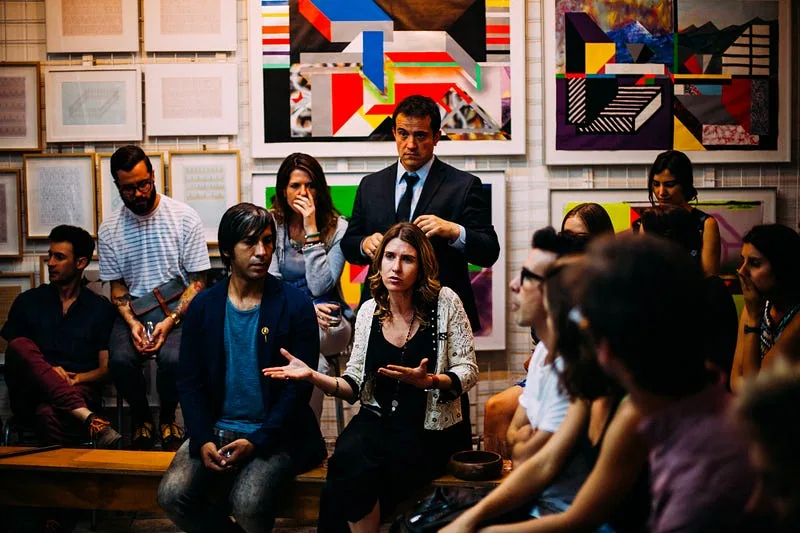
It’s almost impossible to change an opinion. Perhaps there is some mechanism of memetic defense, in the best Richard Dawkins style, protecting the ideas that have already infiltrated the mind and closing the doors to all the others. Maybe people are just stubborn.
From the academic to the least educated, when faced with an opposite and unquestionable argument, the process is similar. The denial is immediate, the eyes widen, fixed on the interlocutor to demonstrate a security that they do not possess. In the background, their minds search anxiously for an exit, a breach, a way to save their dear idea of logical extinction.
While this gap does not arise, the way out is the fallacy. They repudiate the knowledge and training of the adversary (“you didn’t study the formation of the modern state!”, “have you read Capital? All Volumes?”), in an attempt to disqualify him.
If it doesn’t work, they quote Adam Smith or Marx, Schopenhauer or Hegel, and any foreign-born intellectual they can remember, extolling their own intellectualism and hoping that the adversary has never heard of it. Or worse, they inconsequently drag to their side great minds of science and philosophy, as if their titles alone were enough to overturn any argument (“but Einstein was an atheist!”, “but Einstein was a Jew!”).
When none of this works, the solution is to divert attention by quietly manipulating the argument to a convenient bias, escaping from the blue screen of death and opening the door to new possibilities. Powerful exit, since it forces the opponent to position himself to a new argument, losing the focus of the open question.
Citing authors, education and ready-made phrases are not arguments, they are maneuvers to get away from them. Argument is all that you understand enough to explain in your own words, in a way that anyone can understand.
But the real problem with the discussions is that they should not be viewed as a battle in which the best wins. It’s from this reasoning that the popular culture of “sealing” or “Deal With It” emerged, closing any subject to the surface with sagacious superiority. A position that constrains, rather than contributes.
In a dialogue the real objective is the deconstruction, not only of the opinion of the other, but of his own. The dialogue must build new understandings, with contributions from both sides, even if they remain different from one another.
More importantly, a dialogue isn’t possible if there isn’t total freedom and willingness to assimilate new ideas. That’s why a debate between atheists and believers leads nowhere, just like Right and Left. Neither side is willing to deconstruct it’s speech, let alone open to assimilate opposing ideas. It’s not a dialogue, it’s a battle, and winning is the only option. But that does not mean that battles are a complete waste of time.
Even if atheists can not convince believers to abandon their prayers or the Right does not convince the Left to privatize the state, a debate is important because it also involves a third participant, the discreet, and often scorned, spectator.
Excluding the supporters of both sides, among the spectators of a debate are many people who do not yet have a definite opinion. They tend to one side, without feeling confident to embrace one position or another. It may be a non-practicing believer, perhaps an agnostic, or even someone who defines himself as centric or apolitical. It’s for these people that the debates exist.
During the debate, opposing arguments are presented and the moods are exalted. The one who has the best oratory does better in the debate, even if that doesn’t mean he is right. To know this difference is the role of the third participant, absorbing everything a debate has to offer and building a new opinion.
An attentive spectator, at least, will have new and better arguments to defend everything he already believes.