Published on · 4 min read · Ler em Português
Suppressed instinct
How far are we from nature? To answer, of course, we must first define what nature is.
- Environment
- Instinct
- Humanity
- Books
- Nature
How far are we from nature? Of course, to answer, we must first define what nature is.
For some it is the grass that covers the backyard or garden planter. For others, it is the city park or the farmhouse with pool at the weekend. Personally, I consider nature all that humanity has not touched.
I’m wrong, it’s true, because nature has made us fast food eaters who contaminate the planet with microplastics. Yes, it did, because it did everything. We are nature, a small part of it, perhaps a mistake, but we are.
Considering ourselves as something apart from nature must have something to do with the exaggerated size of our claims, just because we are the only species intelligent enough to produce microplastics.
Either way, the untouched nature is difficult. In 350,000 years, Homo sapiens may have urinated in all the bushes out there. Microplastics have already been found in Antarctica, and it wouldn’t surprise me if the Martians would complain about them too. Perhaps it is simpler to consider as nature the places where no human lives or transforms.
Is there somewhere like this near your house? Probably not, or some human would already be there. This is what humans do: they exploit, colonize, and destroy. Historians use many words, but rarely things like: preserve and protect.
Humans do not preserve, because no living being preserves. Mammals, herbivores and even bacteria exploit, because surviving at the expense of others is practically the definition of life. Nature is a scenario of daily battles for nutrients and reproduction that define each individual.
Dogs don’t cut down forests just because they’re not clever and smart enough to create the tools they need or to understand what they could get out of it. Give a chihuahua intelligence and it will enslave its annoying brothers. A little more, and it will produce microplastics.
We are unique in our cruelty and ambition, not because the rest of nature lives in some kind of paradisiacal harmony, but because we are the species that prevailed over the others. Voracious predator number one, capable of destroying the planet on the whim of having peeled and repackaged tangerine on a Styrofoam tray.
If unexplored nature is impossible, it remains to search for places that are little frequented by humans. A place without roads should do.
Do you know any?
A walk around the countryside is enough to discover that there is not a single hill that has not been humanly intervened. Either it’s cut by a road, or it’s got a house, or it’s pasture, or all that stuff.
That little farm that in advertising claims to be isolated, “to get in touch with nature”, has dozens of neighbors. You can see them, because electricity already lights up their homes, and hear them, because they have a bad taste in music.
Not even satellite imagery helps. Pasture, pasture, plantation, road, a small nature reserve full of humans picnicking and posting photos “in touch with nature.” Where is this little frequented nature I try to settle for?
Except for too steep mountains to cultivate, the banks of some rivers that miraculously survived human efforts to destroy them, and preservation areas, all have people. Have you ever stopped to think that almost every land has an owner? All over the planet?
From my house, the closest I can get to the little frequented nature is the Cantareira State Park. The park is 79 square kilometers, which seems much, at least until it puts in perspective with the great São Paulo and its impressive 7,936 square kilometers. Yes, that’s 8,000 square kilometers of people.
We are many, we are everywhere and we want more. Much more than we need and much more than we should. I speak not only of environmental impact, but of our own lives, after all, what remains to discover and appreciate in a world that tractors have already cut across? Where the other animals live in cages and every landscape has a gourmet porch and an iced coconut seller?
Privileged is the one who climbs a mountain, overcomes an ocean and clears a forest. It is what remains of nature, squeezed among 8 billion humans. Only places where it is still possible to explore and risk, which evolution has designed us to do, but we are hampered by our own ambition.
It is this repressed instinct that draws us into the genres of fantasy and space exploration. We want some of the unknown and the untamed. We miss the fear and surprise of exploring territories without the security of an organized society. The chance to start over or to lose everything.
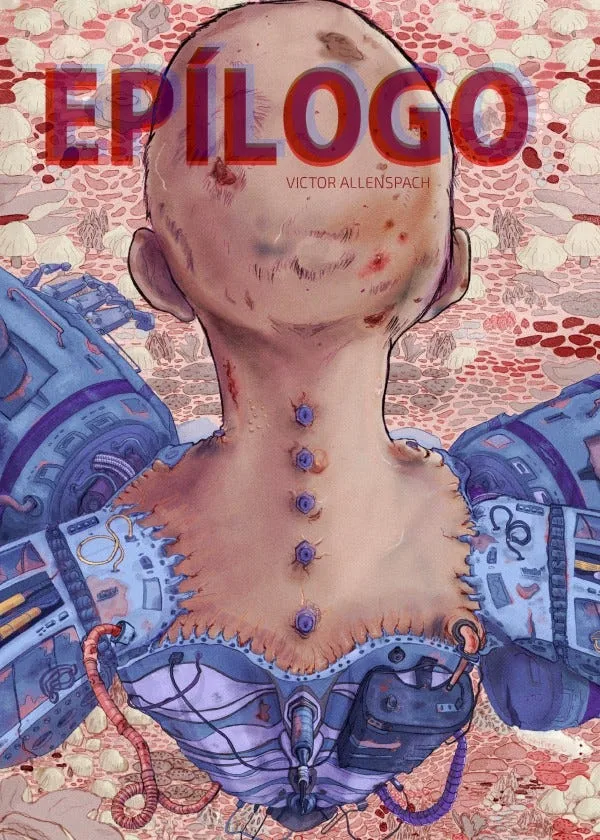
It was behind this feeling that I wrote my most recent book (for now, just avaiable in Portuguese). Epilogue talks about survival in an apocalyptic world, devastated by solar storms. A scenario of deserted cities and dystopian societies reinventing themselves to survive with limited resources and new challenges.
Few left, but the past remains present in traditions that resist change. Convenience of oppressors selected by cradle.